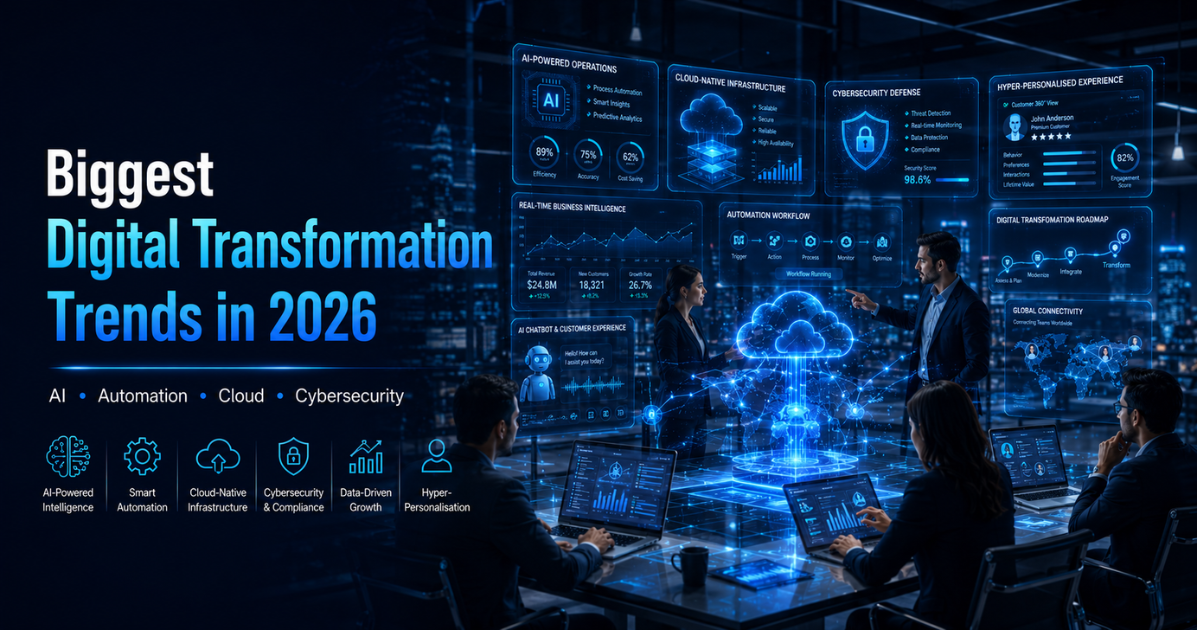
Biggest Digital Transformation Trends in 2026
Every year, businesses talk about going digital. But 2026 is different. The conversation has shifted from "should we transform" to "how fast can we move."
The businesses that were slow to adopt digital tools during the last few years are now feeling the pressure from every direction. Competitors are moving faster. Customers expect more. And the technology available today is far more accessible than it was even two years ago.
Whether you are a founder building a product, a marketing leader trying to prove ROI, an SMB owner watching your margins, or an enterprise buyer managing a large vendor ecosystem, the digital transformation trends of 2026 affect you directly. Here is a clear, honest look at what is actually happening and what it means for your business.
AI Is Moving From Experiment to Everyday Operations
A year or two ago, most businesses were running AI pilots. A chatbot here, a content tool there. These were experiments, not core operations.
In 2026, that phase is largely over. Businesses that have tested AI are now deploying it across their actual workflows. Customer support, sales outreach, financial reporting, content creation, data analysis, and HR processes are all being touched by AI tools that are now mature enough to be trusted with real work.
The shift is significant. AI is no longer a project that sits in the innovation team. It is becoming part of how the business runs on a daily basis.
For founders and startups, this means your competitors are using AI to operate leaner than ever. If you are not building AI into your own processes, you are likely paying more and moving slower than you need to.
Hyper-Personalisation Is Becoming the Standard
Generic marketing is losing its effectiveness very fast. Consumers and B2B buyers alike are now used to experiences that feel tailored to them. When something feels generic, it gets ignored.
In 2026, hyper-personalisation is one of the most important trends across industries. This means using data to deliver the right message, the right offer, and the right content to the right person at the right moment. Not just using their first name in an email, but genuinely adapting the entire experience based on behaviour, preferences, and context.
The technology to do this at scale exists and is now affordable for businesses of all sizes. Marketing leaders who invest in personalisation tools and the data infrastructure behind them are seeing meaningfully better conversion rates and customer retention.
For SMB owners, this is an area worth paying attention to. You do not need an enterprise budget to deliver personalized experiences anymore. The tools are accessible, and the impact on customer loyalty can be substantial.
Cloud-First Is Now Cloud-Native
Most businesses have moved to the cloud in some form over the last decade. But moving to the cloud and being cloud-native are two different things.
In 2026, the trend is towards genuinely cloud-native architecture. This means building and running applications in a way that fully takes advantage of what the cloud offers, flexibility, scalability, resilience, and the ability to spin resources up or down based on actual demand.
Businesses that migrated old systems to the cloud without redesigning them are realising they are not getting the full benefit. The cost savings are smaller than expected. The performance is not much better. And scaling still feels painful.
The trend this year is towards rebuilding or replacing those legacy systems with cloud-native alternatives. For enterprise buyers, this often means significant investment in both technology and the partners who can execute the migration well. For startups, it means there is very little reason to build anything that is not cloud-native from day one.
Cybersecurity Is Getting the Budget It Deserves
For years, cybersecurity was treated as a cost centre. Businesses spent as little as they could get away with, hoping nothing bad happened. That approach is finally, and necessarily, changing.
The number and sophistication of cyber attacks has increased sharply. Data breaches, ransomware, and supply chain attacks have hit businesses of all sizes, and the cost of recovering from one is far higher than the cost of preventing it. In 2026, boards and leadership teams are taking cybersecurity seriously in a way they were not three years ago.
This means increased spending on security tools, more rigorous vendor due diligence, and a growing demand for cybersecurity expertise from both in-house teams and external partners.
For agencies and freelancers working in technology, this is one of the fastest-growing areas of demand. For businesses, it is a reminder that digital transformation without strong security practices is not transformation, it is just risk.
Automation Is Replacing Low-Value Work Across Every Function
Process automation has been talked about for years, but the quality and accessibility of automation tools in 2026 is on a different level from what existed before. Robotic process automation, workflow automation, and AI-driven task completion are now available through tools that do not require a developer to set up.
Businesses are using automation to handle invoice processing, customer onboarding, data entry, report generation, email follow-ups, and dozens of other tasks that used to consume staff time without adding much strategic value.
The result is that employees can focus on higher-value work. Customer interactions, creative thinking, problem-solving, and relationship management are areas where humans still add irreplaceable value. Automation is clearing the path for people to spend more time there.
For SMB owners who are running lean teams and wearing multiple hats, automation tools offer a genuine opportunity to operate at a larger scale without proportionally increasing headcount.
Data-Driven Decision Making Is No Longer Optional
Businesses have always had data. The difference in 2026 is that more businesses are actually using it to make decisions, rather than relying on gut feel or seniority.
The tools for collecting, analysing, and presenting data have become far more accessible. You no longer need a dedicated data science team to understand what is happening in your business and why. Dashboards, automated reports, and AI-generated insights are available through platforms that most teams can use without specialist training.
For marketing leaders, this trend is particularly relevant. Campaigns can now be evaluated in near real time. Budget allocation decisions can be based on actual performance data rather than historical assumptions. And the conversation with the leadership team about marketing ROI becomes much easier when the numbers are clear and up to date.
Enterprise buyers are increasingly requiring their vendors and agency partners to demonstrate how they use data in their delivery process. Agencies that can show data-backed results are winning mandates over those that rely on presentation skills and reputation alone.
Digital Transformation Is Driving a New Wave of Outsourcing
One important consequence of all these trends is that businesses need more specialist expertise than ever before. AI implementation, cloud-native development, cybersecurity, data infrastructure, automation design, and personalisation at scale all require skills that most in-house teams do not have.
This is driving a new wave of outsourcing and agency hiring. Businesses are looking for specialist partners who can help them move faster on their digital transformation goals without the time and cost of building every capability internally.
The agency market is responding. Digital transformation consultants, AI implementation specialists, cloud architecture firms, and full-service technology agencies are all seeing growing demand. For agencies and freelancers who have built expertise in any of these areas, 2026 is a strong market to be operating in.
The challenge for buyers is identifying the right partners from a crowded and noisy market. Not everyone who claims digital transformation expertise has actually delivered results for businesses like yours.
Conclusion
Digital transformation in 2026 is no longer about catching up. It is about moving fast enough to stay competitive in a market where the pace of change is only increasing. The trends covered here, from AI in daily operations to cloud-native architecture, data-driven decision making, and the new wave of specialist outsourcing, are already shaping how the best businesses are building and growing. If you are looking for the right agency or technology partner to support your digital transformation goals, you can find verified listings, read real client reviews, and compare agency rankings.