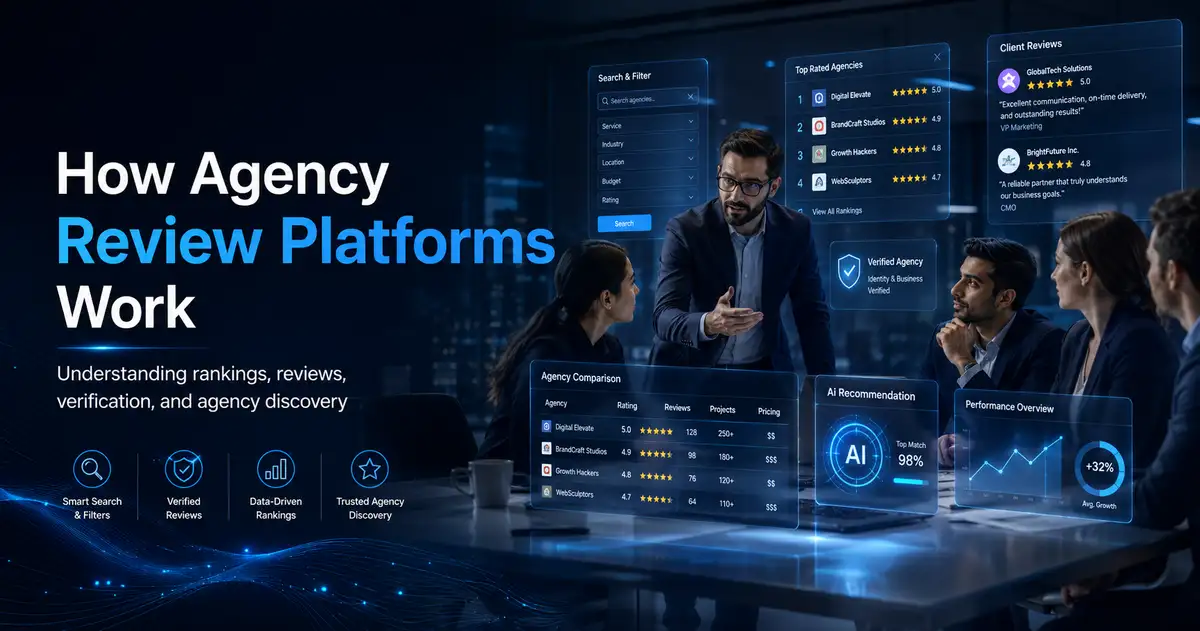
How Agency Review Platforms Work
If you have ever searched for a marketing agency, a web development firm, or a design studio online, you have probably landed on a platform that lists agencies with ratings, reviews, and rankings. These platforms have become a go-to resource for businesses of all sizes before they spend money on any agency or service provider.
But how do these platforms actually work? What happens behind the scenes? And why should you, as a founder, a marketing leader, or a business owner, trust what you read on them?
This article breaks it all down in simple terms.
What Is an Agency Review Platform?
An agency review platform is an online directory where businesses can search for, compare, and evaluate service providers. These service providers can be digital marketing agencies, SEO firms, branding studios, software development companies, PR agencies, freelancers, and more.
Think of it like an online marketplace, but instead of buying physical products, you are finding the right agency partner for your business needs.
Platforms like Gofirms.com sit at the centre of this space. They bring together agency discovery, verified reviews, rankings, and hiring guides all in one place so that buyers and agencies can connect with confidence.
Who Uses Agency Review Platforms?
Before understanding how these platforms work, it helps to know who uses them and why.
Founders and Startups use these platforms to find agencies that have worked with early-stage companies before. Budget matters a lot at this stage, and a good platform helps narrow down options quickly.
Marketing Leaders use them to shortlist specialised agencies for specific campaigns, channels, or industries. They want to see case studies, past work, and what other marketing teams have said about the agency.
SMB Owners often do not have an in-house team and rely heavily on external agencies. They want honest reviews and clear pricing information before committing.
Enterprise Buyers need a more structured process. They look for agencies with the right certifications, team size, and industry experience. Ranking data and detailed profiles help them build a shortlist for RFPs.
Agencies and Freelancers use these platforms to showcase their work, collect client reviews, and attract inbound leads without spending heavily on paid advertising.
How Agency Listing and Discovery Works
The first thing any review platform does is build a database of agencies. Here is how that usually happens.
Agencies Create Their Profile
Most platforms allow agencies to create a free profile. This profile includes basic information like the services they offer, industries they serve, team size, pricing range, location, and portfolio samples.
Some platforms have a manual submission process. Others crawl the internet and auto-generate profiles, which agencies can later claim and update.
Platforms Verify the Information
A good platform does not just list whatever an agency submits. There is usually a verification process. This can include checking if the agency is a registered business, confirming certifications (like Google Partner or Meta Business Partner status), and reviewing the portfolio for authenticity.
On Gofirms.com, the goal is to make sure every listing is accurate and up to date so that buyers can trust what they see.
Search and Filter Tools Help Buyers Narrow Down
Once agencies are listed, buyers can search using filters. These filters typically include:
Service type (SEO, PPC, content marketing, app development, etc.)
Industry experience (healthcare, ecommerce, SaaS, real estate, etc.)
Budget range
Team size
Location or time zone
Average rating
These filters save a lot of time. Instead of going through hundreds of results, a buyer can quickly get to a shortlist of five to ten relevant agencies.
How Reviews Are Collected and Displayed
Reviews are the heart of any agency review platform. They give buyers a realistic picture of what it is actually like to work with an agency.
How Reviews Are Submitted
Reviews are usually submitted by past or current clients of an agency. The process varies by platform, but it generally works like this:
The agency invites a client to leave a review by sharing a link.
The client fills in a structured review form.
The platform verifies the reviewer's identity to reduce fake reviews.
The review goes live after a moderation check.
Some platforms also proactively reach out to buyers to collect reviews, which makes the process less dependent on agencies doing the outreach themselves.
What a Good Review Includes
A well-structured review on an agency platform usually covers:
The type of project or service the client hired the agency for
The overall rating (usually out of five)
Ratings on specific parameters like quality of work, communication, deadlines, and value for money
A written description of the experience
Whether the client would recommend the agency
This gives future buyers a detailed and honest picture rather than just a star rating.
How Platforms Handle Fake or Biased Reviews
This is a genuine concern for any review platform. Agencies have an incentive to get as many five-star reviews as possible, and some might try to game the system.
Responsible platforms tackle this in a few ways. They verify reviewer identities through email, LinkedIn, or business email domains. They look for patterns that suggest fake activity, like multiple reviews coming from the same IP address or reviews submitted within a very short window. They also flag or remove reviews that violate community guidelines.
The credibility of the platform depends entirely on the trustworthiness of its reviews. This is something serious platforms invest in continuously.
How Rankings and Scores Are Calculated
Most agency review platforms publish some kind of ranking or leaderboard. You will often see lists like "Top 10 SEO Agencies in Mumbai" or "Best Branding Firms for Startups."
These rankings are not random. They are based on a scoring system that considers multiple factors.
Common Ranking Factors
Review Quality and Quantity: Agencies with more verified reviews and higher average ratings generally rank better. But it is not just about volume. A few deeply detailed reviews can carry more weight than many shallow ones.
Recency of Reviews: An agency that has been collecting reviews consistently over the past year is seen as more active and relevant than one whose last review was two years ago.
Profile Completeness: Agencies that fill in all sections of their profile, including team size, past clients, portfolio, and certifications, tend to rank higher than those with incomplete profiles.
Client Retention Signals: Some platforms factor in signals like whether clients come back for repeat projects, which is a strong indicator of agency quality.
Platform Activity: Agencies that respond to reviews, update their profiles regularly, and engage with the platform are often rewarded with better visibility.
It is worth noting that most platforms are transparent about how rankings work. If you are evaluating a platform, look for a clear methodology page. If that does not exist, treat the rankings with some caution.
How Hiring Guides Help Buyers Make Smarter Decisions
Beyond listings and reviews, good agency platforms also publish educational content to help buyers navigate the hiring process.
Hiring guides typically cover topics like:
What questions to ask an agency before signing a contract
How to evaluate a proposal or pitch
What red flags to watch out for
How to structure an agency relationship for success
How to compare agency pricing models (retainer vs project-based vs performance-based)
These guides are especially useful for first-time buyers or teams that are hiring an agency in a category they do not have much experience with.
On Gofirms.com, hiring guides are written with specific buyer types in mind, whether you are a founder hiring your first growth agency or an enterprise procurement team running a formal vendor evaluation.
How Agencies Benefit From Being Listed
It is easy to see why buyers benefit from these platforms. But what is in it for agencies?
Inbound Lead Generation
When an agency has a strong profile with good reviews and a high ranking, it starts appearing in searches done by potential clients. This brings in leads without the agency having to spend on ads or cold outreach.
Brand Credibility
Being listed on a reputable platform with verified reviews adds a layer of trust. When an agency shares its Gofirms.com profile with a prospect, it is essentially showing proof of past work and client satisfaction.
Competitive Intelligence
Agencies can also see how they compare to competitors in their category. This helps them identify gaps, whether it is fewer reviews, a lower rating on communication, or a missing service area.
Showcase Specialisation
Generalist agencies often struggle to stand out. A well-filled profile on a review platform allows an agency to clearly communicate its niche, whether that is D2C brand building, B2B lead generation, or mobile app development for healthcare.
What Makes a Good Agency Review Platform
Not all platforms are built equally. Here is what separates a trustworthy platform from one that is just a glorified paid directory.
Verified Reviews: The platform should have a process to confirm that reviewers are real clients and not employees or competitors.
Transparent Rankings: The methodology should be clear and publicly available. Opaque algorithms that seem to favour paid listings erode trust quickly.
Updated Information: Agency profiles should be current. Old logos, outdated service descriptions, and stale reviews reduce the usefulness of the platform.
Unbiased Results: Rankings should not simply reflect who has paid the most. Paid placement can exist, but it should be clearly labelled as sponsored, separate from organic rankings.
Useful Filters and Search: Buyers should be able to narrow down options based on what actually matters to them, not just broad categories.
Buyer-Friendly Content: Guides, comparisons, and articles that help buyers make better decisions are a sign that the platform is genuinely trying to serve its audience.
How to Use an Agency Review Platform Effectively as a Buyer
Knowing how these platforms work helps you get more out of them. Here are a few practical tips.
Read the actual review text, not just the star rating. A four-star review with a detailed description of what went wrong and how the agency handled it tells you far more than a five-star review with only one line.
Look at review recency. An agency with 50 reviews from three years ago may have changed significantly. Prioritise agencies that have been collecting reviews in the past 12 months.
Check the reviewer's context. Some platforms show what industry the reviewer is from and what kind of project they hired the agency for. A review from someone in a similar industry and project type is more relevant to your decision.
Use the shortlist feature. Most platforms let you save agencies to a list. Build a shortlist of five to seven options before starting conversations, rather than reaching out to every agency one by one.
Cross-check with other sources. A good listing on a review platform is a strong signal, but pair it with a look at the agency's own website, LinkedIn page, and any case studies they publish.
The Role of Platforms Like Gofirms.com in the B2B Ecosystem
The B2B services market is large and growing. But it has always had a trust problem. Unlike buying a product on Amazon where you can read thousands of reviews and return it if you are unhappy, hiring an agency involves months of commitment, large budgets, and a lot of relationship management.
Agency review platforms solve this trust gap. They create a layer of accountability. Agencies know their work will be reviewed. Buyers know they can rely on others' experiences before committing.
Gofirms.com is built with this mission in mind. It is not just a directory. It is a space where founders, marketing teams, SMB owners, and enterprise buyers can discover the right agency partner with confidence, backed by real reviews, transparent rankings, and useful hiring resources.
Conclusion
Agency review platforms have changed the way businesses find and hire service partners. If you are looking to hire an agency for the first time or want to make a better decision this time around, using a platform like Gofirms.com is one of the smartest starting points. You can explore top-ranked agencies by category, read verified client reviews, browse our hiring guides for different buyer types, and even compare agencies side by side before making your first call. The right agency partnership can make a real difference to your business, and the right platform makes finding that partner a lot less overwhelming.